
Last Updated on September 3, 2026 by Shitiz Srivastava
150 Countries. 40% of All Ownership. One City.
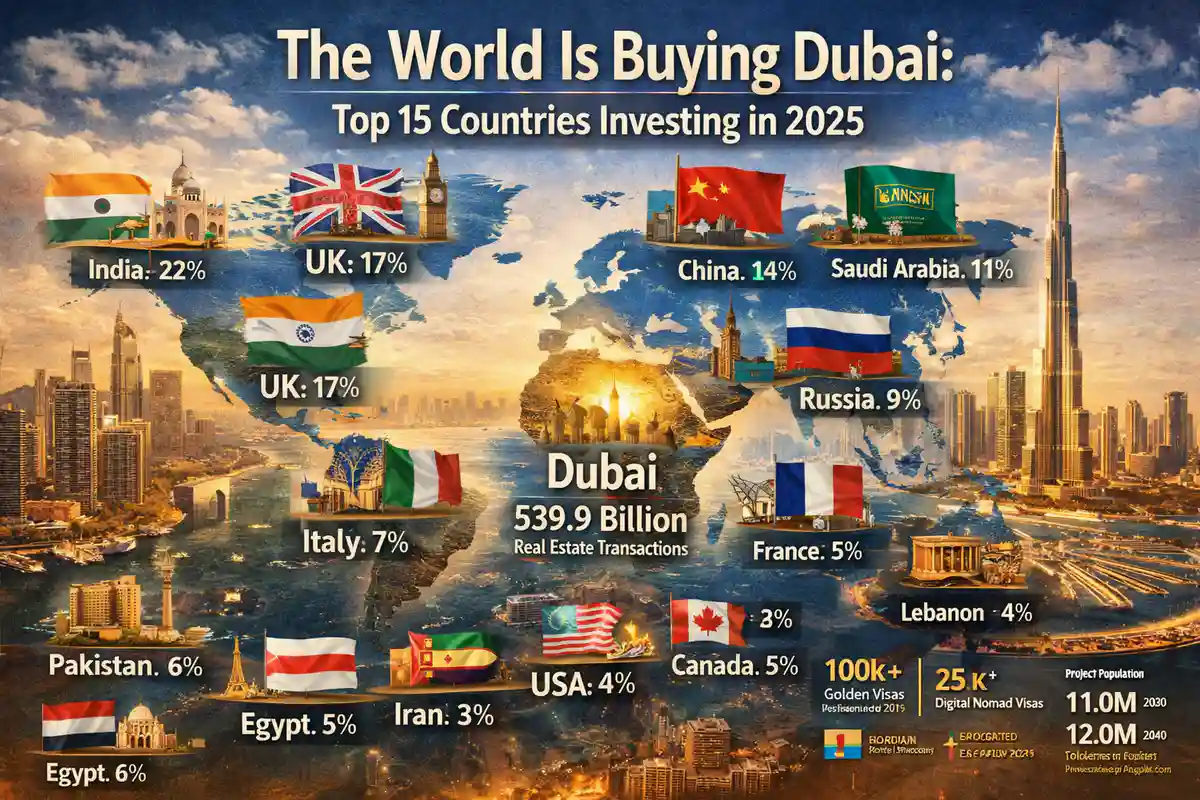
Dubai’s property market has transformed from a regional investment destination into one of the most internationally diverse real estate markets on the planet. By the end of Q3 2025, buyers from more than 150 different countries had completed property purchases in the emirate. Foreign investors now account for more than 40% of all residential property ownership — a figure that continues to grow year on year.
The total value of residential real estate transactions in 2025 reached AED 539.9 billion — a 24.67% increase over 2024. That is not a market approaching its peak. That is a market still building toward it. Behind this number sits a detailed and data-rich breakdown of 15 nations, their spending levels, their resident populations in the UAE, and their trajectory.
15 Countries Investing in Dubai Property: Share, Value & Expat Population
The table below consolidates Dubai Land Department data, independent market reports, and UAE population statistics into a single reference. Buyer share figures represent each nationality’s proportion of total foreign property purchases. Investment values are estimates based on available transaction data. Expat populations are based on 2025 UAE demographic reports.
| # | Country | Buyer Share | Est. Investment Value | UAE Expat Population | Share Bar | Trend |
|---|---|---|---|---|---|---|
| 1 | 🇮🇳 India | 22% | AED 30B+ (~$8.1B) | 4.36 million (38.45%) | ↑ Rising | |
| 2 | 🇬🇧 United Kingdom | 17% | AED 14.7B (~$4B) | ~240,000 | ↑ Rising | |
| 3 | 🇨🇳 China | 14% | AED 2B+ (~$545M) | ~250,000 | ↑ Rising | |
| 4 | 🇸🇦 Saudi Arabia | 11% | AED 12.5B (~$3.4B) | Large GCC community | ↑ Rising | |
| 5 | 🇷🇺 Russia | 9% | AED 14.7B (~$4B) | ~100,000 est. | → Stable | |
| 6 | 🇪🇬 Egypt | 6% | AED 4B+ est. | ~480,000 (4.23%) | ↑ Rising | |
| 7 | 🇮🇹 Italy | 7% | AED 3.5B+ est. | ~30,000 | ↑ +2% from 2024 | |
| 8 | 🇵🇰 Pakistan | ~8% | $12B (~AED 44B) est. | 1.9 million (16.72%) | ↑ Rising | |
| 9 | 🇫🇷 France | 5% | AED 1.6B (~$435M) | ~35,000 | ↑ Rising | |
| 10 | 🇨🇦 Canada | 5% | AED 3B+ est. | ~50,000 est. | ★ New entrant | |
| 11 | 🇱🇧 Lebanon | 4% | AED 1.7B (~$462M) | ~400,000 est. | → Stable | |
| 12 | 🇮🇷 Iran | ~3% | AED 2B+ est. | ~540,000 (4.72%) | → Stable | |
| 13 | 🇺🇸 USA | ~3% | AED 2B+ est. | ~50,000 est. | ↑ Rising | |
| 14 | 🇯🇴 Jordan | ~2% | AED 2B (~$545M) | ~200,000 est. | → Stable | |
| 15 | 🇩🇪 Germany | ~2% | AED 1.5B+ est. | ~30,000 est. | ↑ Rising |
The Five Nations Driving Dubai’s Property Market
India (22%) leads by a clear margin. With 4.36 million residents in the UAE — 38.45% of the total population — Indians are already the fabric of daily life in Dubai. Investment is driven by currency diversification (the rupee’s depreciation against the dollar-pegged dirham), rental yields of 6–8% in Dubai Marina and Business Bay, and a vast, established expat network that reduces the information barriers most foreign buyers face. Indian investors are projected to exceed AED 30 billion in purchases by year-end 2025.
The United Kingdom (17%) holds second place with AED 14.7 billion in investments. Cash purchases by British buyers rose 60% year on year in late 2025 — a signal of committed, long-term investors rather than yield-chasers. Rising UK property taxes, the abolition of the non-domicile tax regime in April 2025, and inflation at home have accelerated the outward movement of British capital. Dubai’s zero income tax on rent, zero capital gains tax, and zero annual property tax make the financial case almost write itself.
China (14%) is the comeback story of 2025. After pandemic-era restrictions suppressed activity, Chinese capital has returned at scale — driven by domestic property market instability, stronger UAE-China trade ties, and a growing appetite for overseas wealth preservation. Chinese buyers focus on branded tower developments in Downtown Dubai and Business Bay, with an average ticket size among the highest of any nationality.
Saudi Arabia (11%) benefits from geographic proximity and deep cultural ties with the UAE. Saudi buyers primarily target luxury villas near waterways at Downtown Dubai and Palm Jumeirah, often purchasing second homes rather than investment properties. Their share grew 1% year on year and is expected to continue rising as Dubai’s luxury residential pipeline expands.
Russia (9%) remains a consistent and significant force, contributing AED 14.7 billion concentrated in waterfront properties. Geopolitical uncertainty continues to motivate Russian HNWIs to hold assets outside their home market, and Dubai — with its neutral political position, no-tax structure, and Golden Visa — remains their first choice for capital preservation.
The Nations Quietly Climbing Dubai’s Investor Rankings
Below the top five, several nationalities are growing their presence in Dubai’s property market at a pace that deserves attention. Italy climbed 2 percentage points in a single year to reach 7%, with Italian buyers drawn to Emirates Hills and luxury family retreats. France holds steady at 5%, with AED 1.6 billion in transactions concentrated in Palm Jumeirah. Egypt — with nearly 480,000 residents in the UAE — accounts for 6% of buyers, active primarily in mid-market apartments.
Pakistan’s figures stand apart. With 1.9 million residents in the UAE (16.72% of the total population), Pakistanis represent the second-largest South Asian expat community in the country. Their investment reached approximately $11 billion in 2024 and is expected to grow to $12 billion in 2025 — figures that rank them among the largest investors by absolute value despite holding a smaller percentage share of transactions, given their focus on mid-range and off-plan properties.
Canada is the most significant new entrant. Holding 5% of buyer share — a position that did not exist two years ago — Canadian investors have entered driven by Golden Visa eligibility, Dubai’s zero-tax structure, and rental yields that far exceed what is available in Toronto or Vancouver. Lebanon (4%), Iran (~3%), the USA (~3%), Jordan (~2%), and Germany (~2%) each maintain consistent, growing presences that collectively add hundreds of millions of dirhams in annual transactions.
Dubai Is Not at Peak Demand — It Is Still Building Toward It
More than 100,000 Golden Visas have been issued through property purchases since 2019 — and that pipeline is accelerating. Each visa issued is a long-term commitment to Dubai, converting investors into residents and residents into repeat buyers. In early 2025 alone, over 25,000 Digital Nomad Visas were issued in Dubai — a brand-new category of future buyer: remote workers converting temporary stays into long-term property ownership.
The demographic foundation underpinning future demand is equally compelling. The UAE’s population is projected to grow from approximately 11.3 million today to 11 million by 2030 and over 12 million by 2040. Every new resident is a potential buyer or tenant. With 88.5% of the UAE’s current population made up of expatriates from over 200 countries, Dubai’s property market has a structural demand base unlike any other city in the world.
Also Read : Top Countries Investing in the UAE — Ranked by Capital and Share
Also Read : Why I Believe Dubai Is Changing the Wealth Game for Indians
Related posts:
![Top property developers in UAE with Dubai skyline, Burj Khalifa and waterfront residential towers view]()
Top Property Developers in the UAE: The Names Behind Dubai's Iconic Skyline
![Dubai Tax and Property Q&A section image showing DTP expert answers on UAE tax, crypto regulation, and property investment]()
Dubai First-Time Home Buyer (FTHB) Program: A Full Overview
![Can Foreigners Buy Property in Dubai? Non-Resident Rules, 100% Ownership an...]()
Can Foreigners Buy Property in Dubai? Non-Resident Rules, 100% Ownership an...
![Dubai Property Buying Costs (2026): Every Fee Explained, From DLD to DEWA]()
Dubai Property Buying Costs (2026): Every Fee Explained, From DLD to DEWA
![Shahrukhz by Danube tower in Dubai with Shah Rukh Khan branding and skyline view sold out commercial project]()
How Shahrukhz by Danube Turned Out to Be a Masterstroke Idea?




1 thought on “The World Is Buying Dubai: 15 Countries, Their Investment Numbers, and Where This Is All Heading”