
Last Updated on September 13, 2026 by Shitiz Srivastava
I know this question may have surrounded your mind whenever you have tried to get into the property market that why the downtown property market of Dubai is so expensive compared to the property markets of other places.
Downtown Dubai property prices stay high because the area combines extreme land scarcity, the world’s most recognisable skyline landmarks, and Emaar’s tightly managed master-planned environment, all packed into roughly two square kilometres.
Anyone who has seriously compared apartments across central Dubai notices this quickly.
Downtown consistently costs more per square foot than nearby districts, and the gap is too large to explain by unit size alone.
In several cases, the difference isn’t down to apartment size at all. It only becomes clear once you look at the full picture.
Scarcity is one part of the answer and Lifestyle can be another.
And so is the value attached to the address itself, meaning where it actually sits on the map.
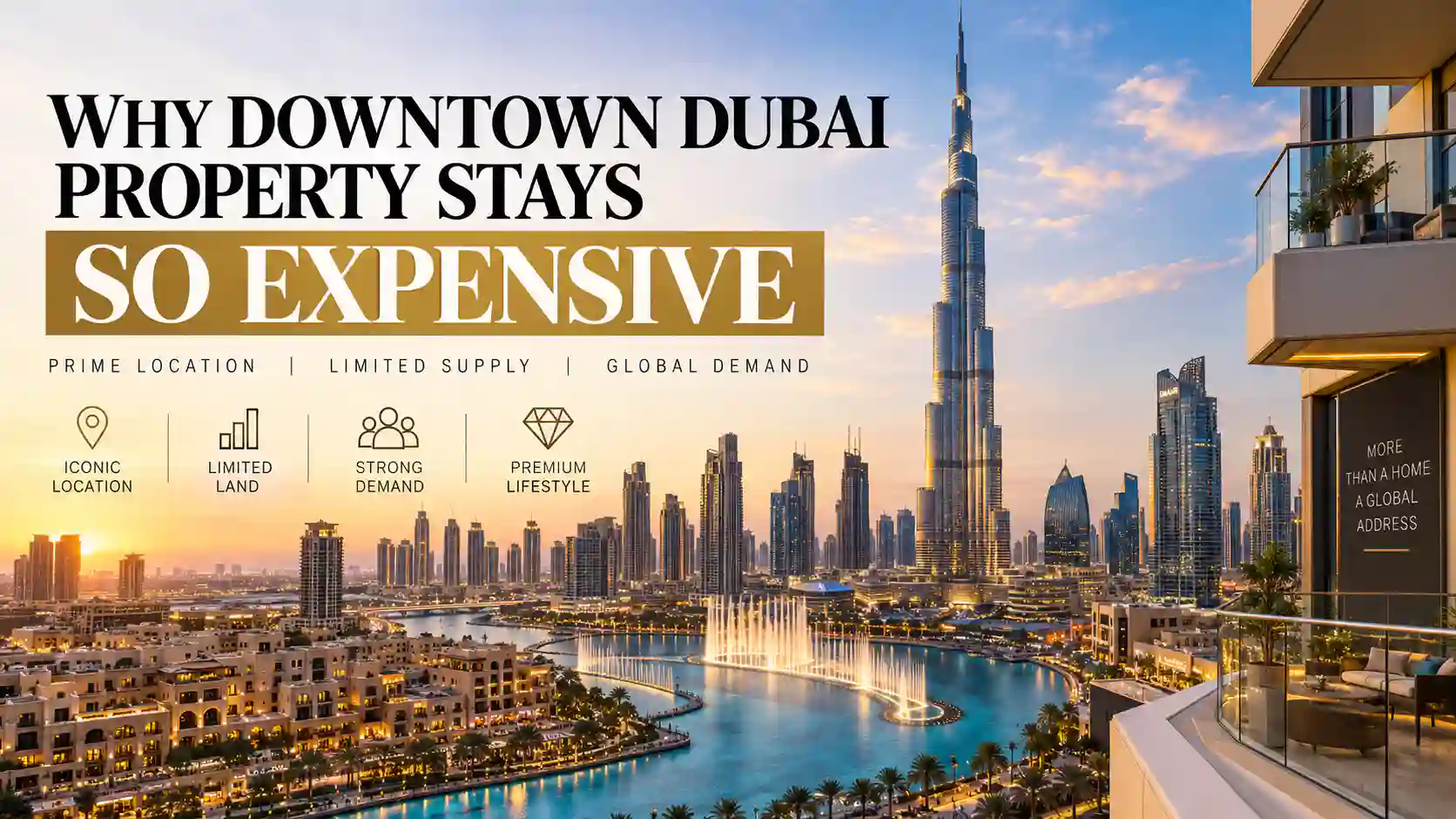
Downtown Dubai is home to the immensely popular Burj Khalifa, Dubai Mall and Dubai Fountain, all within a relatively compact, largely built-out part of the city.
Whenever any celebrity comes to Dubai, downtown is the first place he visits. Most of the events are happening in downtown Dubai only.
So it has become the poshest area of Dubai, like the South Bombay of Mumbai or like the Fifth Avenue of the United States.
Compare that with newer master communities where developers still have large areas of land available for future projects and you will realize that Downtown simply has less room to keep adding homes at scale because it is already quite developed.
It is a simple pattern. When population and construction both increase in an area, prices tend to move up along with them.
There is also an important distinction buried in the numbers themselves.
Current 2026 data from Bayut and Property Finder puts Downtown apartment prices at roughly AED 3,100 to AED 3,400 per square foot on a listing basis.
Full-year 2025 resale data compiled by Metropolitan Premium Properties from Property Monitor, however, puts the average at AED 2,763 per square foot, across 2,464 completed sales, with prices up 6.3% year on year.
Those numbers aren’t necessarily contradictory.
They are measuring different parts of the market.
Portal indices can reflect asking prices and the mix of properties currently being marketed, while resale transaction data reflects completed deals.
A Burj Khalifa-facing apartment listed today and an older apartment that actually sold six months ago are not the same data point.
Location Does Most of the Heavy Lifting
Downtown isn’t simply another residential neighbourhood. It is one of Dubai’s best-known addresses.
Emaar developed the community around landmarks including the Burj Khalifa, Dubai Mall and Dubai Opera, with hotels, restaurants, retail and entertainment concentrated around them.
For a city where getting from one place to another often means getting in a car, that concentration matters.
You can live in Downtown and walk to places that people fly into Dubai to visit.
That helps explain why two apartments with similar floor areas can sell for very different amounts.
A clear, unobstructed view of the Burj Khalifa or Dubai Fountain can add a substantial premium, depending on the building, floor, orientation and quality of the view.
There is no reliable like-for-like study that allows us to say, for example, that a Burj view adds exactly 10% or 20%. Anyone quoting a precise figure without explaining the underlying transactions should therefore be treated cautiously.
Why Limited Land Keeps Downtown Dubai Property Prices High
The other part of the equation is supply.
Emaar puts Downtown’s footprint at roughly two square kilometres, and much of the prime land around Sheikh Mohammed Bin Rashid Boulevard and the Burj Khalifa precinct has already been developed.
That is very different from communities such as Dubai South or Dubai Creek Harbour, where developers still have substantial room for new phases and projects.
Downtown can still see new development, but the scale is different.
New projects are more likely to involve individual towers, infill sites or redevelopment rather than the kind of huge residential expansion possible in a new master community.
That matters because new supply is one of the easiest ways for a market to absorb rising demand.
Downtown has less of that flexibility.
This scarcity is a major reason Downtown Dubai property prices sit above nearby communities.
Current 2026 portal indices put Downtown at a noticeably higher price per square foot than the AED 2,763 average recorded for 2025 resale transactions.
The figures should not be treated as directly interchangeable, but the gap does illustrate how much higher the market can price newer or currently marketed stock than the existing resale base.
Rental Demand Is Real, but Short-Term Yields Need Caveats
Downtown draws two very different types of tenants.
There are professionals who want a central address close to offices, restaurants and amenities. Then there are visitors who want to stay close to the Burj Khalifa, Dubai Mall and the city’s main attractions.
And then there are those who want both, because the male head of the family is going to work while the females of the family and the younger ones of the family are going to all the beautiful places of Dubai to explore.
That gives landlords a relatively broad pool of potential tenants.
Reported gross rental yields are generally in the 5 to 6% range.
Metropolitan’s full-year 2025 report puts Downtown at 6.02%, and Property Finder’s figure, based on its trailing 12-month listing data, is close to 5.0%.
Other portals and reports quote figures across that same 5–6% band, depending on methodology.
The exact number matters less than the broader point.
Downtown is expensive to buy, but rents are high enough to produce a respectable gross yield, a trade-off worth weighing against the alternative in our renting vs buying guide. Do give it a read.
The short-term rental market is a little more complicated.
Downtown’s location clearly helps holiday-home demand, but it does not automatically mean that a short-term rental will outperform a conventional annual lease. Occupancy, nightly rates, management fees, cleaning, platform commissions, furnishing and licensing costs can all change the calculation.
There is also a regulatory requirement that should not be overlooked. Holiday homes in Dubai have to be registered and approved under the Department of Economy and Tourism’s holiday-home framework before they can legally be listed. That’s a separate requirement from the Trakheesi permit that every Dubai property listing needs.
So a headline such as “Downtown Airbnb yields 10%” should not be taken at face value without knowing the unit, purchase price, occupancy assumptions and costs behind it.
Emaar’s Role Is Real, but Don’t Overstate It
Emaar Properties developed Downtown Dubai and remains its master developer. Emaar Community Management (ECM) provides association and community-management services within the development, and Emaar’s own rules for the district set out how common areas are overseen and maintained.
That gives Downtown an established development and management structure, which can matter to buyers who are thinking about the condition of common areas, facilities and the long-term identity of the community.
But there is a line between saying that Emaar’s reputation supports buyer confidence and claiming that the Emaar name itself adds a measurable percentage to a property’s value.
There isn’t enough evidence to make the latter claim confidently. The same applies to claims that lenders necessarily treat Emaar properties as lower-risk assets.
In other words, Emaar is part of the Downtown story. It shouldn’t be turned into a statistic that the data doesn’t support.
Downtown Dubai Property Prices vs Other Areas
Neighbourhood comparisons only become useful when the underlying numbers are measured in the same way.
The table below uses full-year 2025 resale-transaction data from Metropolitan Premium Properties, based on Property Monitor data.
| Area | Avg. price/sq ft (AED), FY2025 resale | YoY change | Gross yield |
|---|---|---|---|
| Palm Jumeirah (villas) | 6,938 | +0.3% | ~3.0% |
| Palm Jumeirah (apartments) | 3,227 | +13.9% | ~5.0% |
| Downtown Dubai | 2,763 | +6.3% | ~6.0% |
| Business Bay | 2,053 | +9.4% | ~6.7% |
| Dubai Marina | 1,967 | +11.1% | n/a |
These figures exclude off-plan primary sales.
More recent 2026 portal indices show higher absolute prices, with Bayut putting Downtown around AED 3,300–3,400 per square foot and Palm Jumeirah around AED 4,300 on a listing basis. Those figures are useful for understanding where the market is being priced today, but they should not be confused with the price at which a completed transaction actually took place.
On the 2025 resale numbers, Downtown Dubai property prices sit comfortably above Business Bay and Dubai Marina, while Palm Jumeirah is more expensive.
That makes sense to a degree. Palm Jumeirah has a different supply profile and a large concentration of ultra-luxury villas and beachfront properties. Downtown, by contrast, is a much denser mixed-use urban district.
Yet buyers continue to pay a premium for Downtown.
The apartments themselves aren’t necessarily bigger or better finished than what’s available elsewhere. The premium comes from the location, which carries real value on its own. The landmarks, the walkability, the established infrastructure, the limited development footprint and the prestige attached to the address all come together in one relatively small area, part of a broader pattern in why Dubai property became a global wealth magnet.
Downtown has also experienced substantial long-term appreciation since its development, although the journey has not been smooth. Dubai’s property market has gone through major cycles, including the sharp correction during the 2008–09 financial crisis.
The same qualification applies to resale liquidity. Downtown has a large and established pool of investors and end-users, which can support resale demand, but that does not mean every apartment sells quickly. Building quality, floor, view, layout, service charges and asking price can make a significant difference.
Frequently Asked Questions
Is Downtown the most expensive area in Dubai?
No. Palm Jumeirah currently records higher average prices on both transaction and portal measures, particularly for villas. Downtown remains one of the city’s most expensive mainstream residential districts, but it is not the absolute ceiling.
Why is Downtown pricier than Marina or Business Bay?
Downtown Dubai property prices run higher than Marina or Business Bay mainly because of location, limited scope for large-scale new supply, proximity to the Burj Khalifa and Dubai Mall, and the established Emaar development and management structure.
Will Downtown property prices keep rising?
Nobody can say that with certainty. Prices have moved higher through 2025 and into 2026, but Dubai’s property market is cyclical. Interest rates, buyer demand, new supply and broader economic conditions can all change the direction of prices. See, for example, how Iran-US tensions have affected Dubai property prices earlier in 2026.
Does buying in Downtown guarantee good rental income?
No. Rental performance depends on the individual property. The building, floor, view, purchase price, service charges, occupancy and choice between a long-term lease and a licensed short-term rental can all materially affect the return.
Methodology
Two datasets are used in this article.
The first is full-year 2025 resale-transaction data from Metropolitan Premium Properties, sourced from Property Monitor. The second consists of current 2026 listing indices from Bayut and Property Finder.
They are deliberately not presented as interchangeable numbers. The first reflects completed resale transactions, and the latter reflects current market listings and asking-price data. Property type and the mix of units being marketed can also affect the averages.
The Dubai Land Department publishes transaction-level real estate data and is the appropriate source for checking individual transactions and current official records.
This article has not been reviewed by a lawyer or checked against RERA marketing or disclosure requirements. It is intended as general informational content, not legal, financial or investment advice.
Before relying on any figure for a purchase or investment decision, check current DLD transaction data or speak to a RERA-licensed real estate professional. Property prices can change significantly from one quarter to the next.
External Sources
- Metropolitan Premium Properties. Downtown Dubai Apartments 2025 Resale Report. Property Monitor transaction data, used for the 2025 Downtown resale price, transaction volume, total resale value, and rental yield. https://metropolitan.realestate/resale-reports/downtown-dubai-apartments-2025-resale-report/
- Metropolitan Premium Properties. 2025 Resale Reports for Business Bay, Dubai Marina and Palm Jumeirah (apartments and villas). Property Monitor transaction data used for the comparative table. https://metropolitan.realestate/wp-content/uploads/2026/01/Business-Bay-A.pdf · https://metropolitan.realestate/wp-content/uploads/2026/01/Dubai-Marina-A.pdf · https://metropolitan.realestate/wp-content/uploads/2026/01/Palm-Jumeirah-A.pdf · https://metropolitan.realestate/wp-content/uploads/2026/01/Palm-Jumeirah-V.pdf
- Bayut. Downtown Dubai Property and Apartment Market Analysis. Used for current 2026 portal/listing-index pricing (AED 3,354/sq ft for apartments, AED 3,330/sq ft for properties, as of mid-2026). https://www.bayut.com/property-market-analysis/index/sale/properties/dubai/downtown-dubai/ · https://www.bayut.com/property-market-analysis/index/sale/apartments/dubai/downtown-dubai/
- Property Finder UAE. Properties for Sale in Downtown Dubai. Used for current listing-based price per square foot (approx. AED 3,200/sq ft) and the approx. 5.0% rental-yield figure, based on Property Finder’s trailing 12-month listing data. https://www.propertyfinder.ae/en/buy/dubai/properties-for-sale-downtown-dubai.html
- Emaar. Downtown Dubai. Source for Downtown’s status as Emaar’s flagship development, its approximate two-square-kilometre footprint, and its major landmarks. https://www.emaar.com/en/our-communities/downtown-dubai
- Emaar Community Management (ECM). Downtown Dubai community materials and formal rules. Source for ECM’s role in association and common-area management within Downtown. https://www.ecm.ae/en/flipbook/downtown-dubai-community-q1-of-2025/ · https://www.ecm.ae/wp-content/uploads/2026/01/Emaar-Formal-Rules-and-Regulation-Verticals-Downtown-Dubai.pdf
- Dubai Department of Economy and Tourism (DET). Holiday Home Permit. Government source confirming that apartments and villas must be registered and approved before being listed as holiday homes. https://www.dubaidet.gov.ae/en/services/apply-for-a-holiday-home-permit
- Dubai Legislation Portal. Administrative Resolution No. (1) of 2020. Official Dubai legislation setting out the requirements and procedures for holiday-home permits. https://dlp.dubai.gov.ae/Legislation%20Reference/2020/Administrative%20Resolution%20No.%20%281%29%20of%202020.html
- Dubai Land Department. Real Estate Data. Official government source for transaction, rental, project, and developer data, and the appropriate reference for verifying any individual transaction or current market record. https://dubailand.gov.ae/en/open-data/real-estate-data/
This article is for general informational purposes only and does not constitute financial, investment, or legal advice. Figures from property portals are indicative and may not reflect what any individual transaction achieved. Verify current data with a licensed real estate professional or the Dubai Land Department before making investment decisions.
Related posts:
![Unmarried couple viewing the Dubai skyline from an apartment, illustrating UAE laws on unmarried couples living together.]()
Can Unmarried Couples Stay Together in Dubai or is living live-in relation ...
![UAE Civil Personal Status Law for Non-Muslims]()
Federal Decree-Law No. 41 of 2022: The UAE's Civil Personal Status Law for ...
![UAE and Dubai crypto regulation overview showing VARA, ADGM FSRA, DFSA frameworks, licensing, taxation, and regulatory evolution from 2023 to 2026]()
Cryptocurrency in UAE & Dubai (2026): Laws, VARA Licences, Tax, and Mar...
![Dubai Tax and Property Q&A section image showing DTP expert answers on UAE tax, crypto regulation, and property investment]()
Is RERA in Dubai the Same as RERA in India, or Do They Work Differently?
![Dubai Myths vs Reality 2026 showing tax-free claims, 9% UAE corporate tax, property hype, and legal risks for Indian investors]()
Dubai Myths vs Reality 2026: Tax-Free Truth, Property Hype & Legal Risks


